Media Report — September 2026
Back to business travel — but only short-haul so far. You’ll know when I’ve done a long-haul trip when I post a report with several films and entire TV series in it!
Reading
The Birth of Communist China, C.P. Fitzgerald
This is a book about China, first published in 1952, although this is the updated edition, published in 1966. Mine is in fact my Dad’s own copy, bought during his university years.
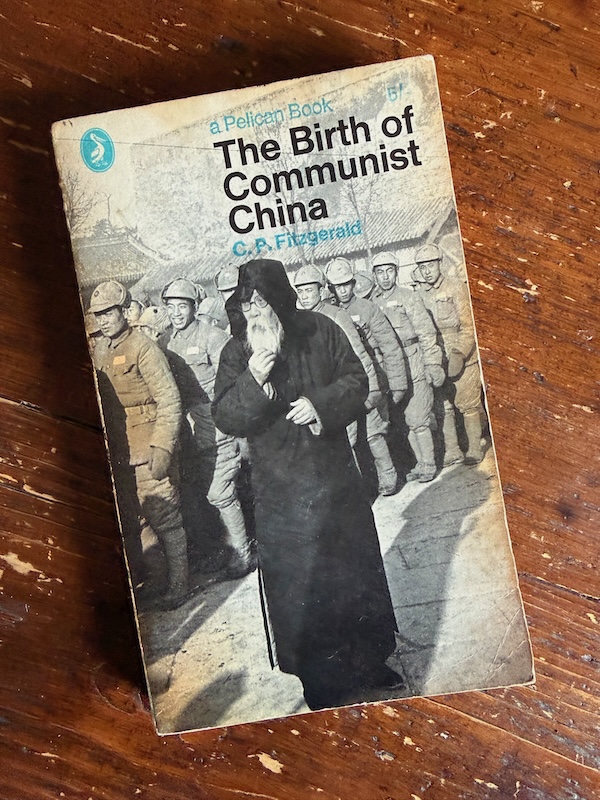
I was curious to read it, because I have very little formal education about China and its history, except for odd bits here and there. My ignorance made this a slow read because I was constantly stopping to refer to Wikipedia, and then getting side-tracked by the amazing stories and fantastic depth of history that I was finding. All the changes in anglicised spelling of Chinese names since the book was first published did not help, either! Fortunately I am sufficiently used to the (sometimes startlingly) different Latinisations adopted in various European languages that I could usually make out what was going on, but it’s quite obvious that the Latin alphabet is not remotely suited to rendering Chinese place-names. In fact I am starting to think that we should not even try, and just use a Westernised place name that non-Chinese-speakers will not butcher. Chinese people take this approach with their own names, after all; I was moderately offended when I learned this fact, and then when I thought about it a bit more, I think it makes a lot of sense.
Anyway, the author is a deeply sympathetic Old China Hand — not that I can judge the actual content, but the opinions are backed up by facts, and my parallel readings in Wikipedia did not identify any gross discrepancies. His forecasts for the future starting from the 1960s also seem to match up with the major beats of recent Chinese history as I know them. Perhaps this is not surprising given his background:
C. P. Fitzgerald was born in London in 1902, and educated at Clifton College, Bristol.
He lived in China, with brief breaks, from 1923 to 1939, and for four years after the war, from 1946 to 1950. He held the Leverhulme Fellowship for anthropological research in China from 1936 to 1939 and worked in Tali, in Yunnan province. After the war, he was the representative of the British Council in North China. He is now Professor of Far Eastern History in the Australian National University, Canberra.
C. P. Fitzgerald is the author of Son of Heaven, China: A Short Cultural History, Tower of Five Glories, The Empress Wu, Floodride in China, Barbarian Beds, and The Third China, Chinese Communities in S.E. Asia.
The result is a book that I found very readable even in its erudition, with a sometimes arch tone and extremely dry wit, but no notion of a superior outsider discussing quaint native customs. If you too want to learn more about why China is Like That, I can recommend this book — or if I missed ways in which it is wrong or has been superseded, I would love pointers!
Engines of Reason, Adrian Tchaikovsky
This is a sequel to Elder Race, and a sequel that leaves room for further instalments at that. It’s pretty short, a novella more than a full novel, but perfectly formed for all that. A couple of dangled threads made me wonder if this series could tie up with his other Children of Time series, which would be fun. But definitely don’t start here: it’s an interesting setting, but this is a bit too much in medias res.
Halcyon Years, Alastair Reynolds
Malfunctioning generation ships seem to be all the rage right now, between this and Peter F. Hamilton’s Arkship trilogy, which I am looking forward to completing later this year. This one is especially fun because of the hardboiled noir setting, with hard-drinking private eye Yuri Gagarin (yes, that Yuri Gagarin)(well, sort of) and his robot sidekick. Because it’s Alastair Reynolds, it’s all pretty bleak and gothic, but not quite as deeply so as in his Revelation Space books. Could he be mellowing in his old age? Anyway, highly recommended.
Redshirts, John Scalzi
I bought this ages ago when it was on special for 99 cents or whatever, and then promptly forgot about it. I had assumed that it would require more familiarity with Star Trek than just the titular trope, but actually Scalzi’s trademark dizzyingly fast repartee carries the story along even without much (any) background knowledge. I am the guy in the story who gets confused between Star Trek and Star Wars, okay? There may be all sorts of deeper references that flew entirely over my uneducated head, and which I hope the real Star Wars heads get to enjoy. But it was an unexpectedly good read even without that background, with moments of real pathos in between the non-stop quips — classic Scalzi, basically. He is very good at what he does.
Watching
Nirvanna the Band the Show the Movie
I saw this in the plane and enjoyed it immensely. It is very silly and also very earnest, and I could tell you the plot but that’s not the point; I knew it going in and didn’t care at all. There are a ton of film references, especially to Back To The Future, and I imagine if you knew Toronto better than I do, you might pick up on some fun local colour there, but it’s just a really good film. Apparently it had quite the time in development hell, but it doesn’t seem to have done it any long-term harm.
Silo
I’ve read (and enjoyed) the books so, much like with Nirvanna the Band the Show the Movie, there were no surprises for me in terms of unexpected plot twists, but the ending of Season Three was still genuinely chilling. No spoilers, in case you have not read the books, but wow. If you’ve not been watching, or if you bounced off what was admittedly a slow start, you can get back into it now, or plan to binge it all next summer when the fourth and final season drops. Highly recommended (both the books and the films), despite the brevity of this review.
Apple is really on a roll with their SF TV offerings lately: Foundation, For All Mankind, Severance, and more, every one a banger — and Neuromancer still to come! I just wish they could take over The Peripheral and finish it properly…
The Grand Tour
Cards on the table: I loved old Top Gear with the classic trio of presenters, even though it was getting increasingly silly towards the end. I did give the later incarnations a chance, but never felt that they got the balance right. It’s a show about three friends who really like cars, and you have to get both of those elements right or the balance is off. My fantasy post-trio casting would actually have been Chris Harris, Rory Reed, and a third presenter to leaven the car geekery — basically, the Extra Gear format, given room to breathe and develop into its own thing. Instead, that add-on was summarily killed off, in favour of promoting Chris Harris to the main show, but pairing him with some idiot comedian I had never heard of and never care to hear of again, and a cricketer who seemed nice enough for a jock but, as it turned out, couldn’t drive as well as he thought he could — who both spent more of their time bullying Chris Harris than doing anything with cars.
Some of my fellow fans of old Top Gear went all-in on Clarkson’s farming adventures, but I just saw someone disappearing up his own character’s fundament. I did enjoy James May’s Our Man In… adventures, but not in any way as Top Gear methadone, more as their own thing.
All of this is to say that, for me, The Grand Tour with Clarkson, Hammond, and May had a very high barrier to overcome, and mostly, it didn’t. Oh, it had its moments, but most of the time, what it did was to remind me of how much better old Top Gear had been, and make me consider watching a rerun of that instead. But on the other hand, this meant that I was far less wedded to the original presenters still being on the show, and was correspondingly open to giving the new trio a chance.
So far, it looks like Amazon has avoided the BBC’s failure of trying to recreate the original formula in isolation without access to any of the original ingredients. The new presenters all seem to be genuine car nerds — which should not be a surprise on a car show, but it is a very welcome one at this point in time. What is more, they also seem to be able to interact with each other as people, which is something that none of the slates of alternate Top Gear hosts ever seemed to nail.
In a more meta way, too, The Grand Tour recognises that car shows are not what they used to be. Top Gear started out as a show that reviewed real cars that people could buy, with the occasional bit of exotica thrown in. These days, our attitude to cars has changed, probably irrevocably, and I would say, for the good. By and large, people — even car nuts — do not dream of driving a race car every day. This is why the culture of car customisation has mostly died out. Rather, car people have a normal (possibly electric) car that they drive during the week, and then they have, or they lust after, a (modern?) classic or a resto-mod or whatever for the weekend. This shift means that there is no need for a car show to be realistic; instead, it can and should just focus on being entertaining.
After all, this is the only future that internal-combustion sports cars have: they are on the same trajectory as horses, demoted from everyday transportation to playthings for the rich. The schtick of “watch the latest EV pulverise last year’s top IC supercar in a drag race!” has been old for a while now, and while some EVs can also go around corners these days, it’s ultimately a bit pointless to hoon them, whether behind the wheel or in front of the cameras.
So coming all the way around, this new iteration of The Grand Tour is pure entertainment, disconnected from the real world, and fully embraces its nature. The rhythm of the show relies largely on the chemistry among its presenters, rather than any connection to the cars themselves — although there is plenty of that, too. I had no idea who any of them were, apart from that one time that Francis Bourgeois went for a drive with Chris Harris, but so far, on the evidence of this first series, I’m more hopeful than at any time since Clarkson got hangry and punched someone.